
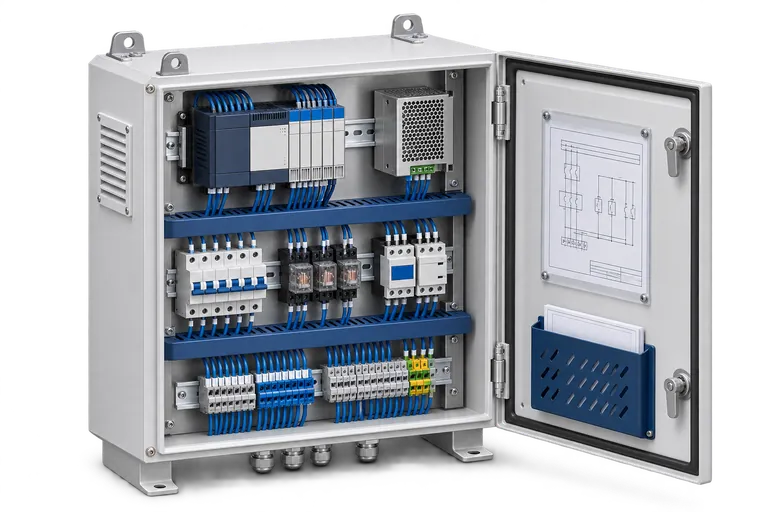
Distinguish plant design from electronics development
An industrial wiring diagram and a printed-circuit-board development project describe different engineering objects. Both represent electrical relationships, but at different levels and through different records. State whether your task concerns installations, control cabinets, products or individual electronic assemblies.
The intended task matters as well. Recognizing symbols and terminals, linking a parts list to a drawing, and answering a technical question across several documents each need different evidence. A precise use case helps separate essential information from interesting additions.
Identify the records that need to stay connected
For an industrial installation, relevant records may include circuit diagrams, terminal designations, component lists and technical documents. For an electronics project, the useful combination may be a schematic, board layout and associated firmware. Ask whether these relationships are preserved in the archive and how they are described, rather than assuming that a shared folder establishes the connection.
KiCad documents schematic design and PCB layout as distinct parts of its development environment. That distinction is useful when specifying a dataset: manufacturing outputs, editable projects and readable documentation are different possible components. Request the level your task needs and explain why. A manufacturing export is not the complete development project.
| Records | Association to establish |
|---|---|
| Electrical and wiring diagrams | The project, installation or product and its corresponding revision |
| Component lists and bills of materials | The positions or references used in the associated diagram |
| PCB projects | The connection between schematic, layout and manufacturing outputs |
| Firmware | The relevant hardware and matching software version |
| Technical documentation | Its scope and association with the same engineering project |
Check editable projects separately from exported outputs
A PDF may be relevant when the task uses information visible on a drawing. Other analyses need structured or editable project files. The authoring software, version and known dependencies therefore belong in the technical discussion. Check whether linked libraries or other project components are needed before assuming that the supplied main file is sufficient.
For PCB archives, distinguish Gerber outputs from native development files and other exports. The information your process can actually use should be tested on specific files. A format label does not replace a representative import test.
Use quantities that reflect the engineering unit
Pages, files, installations and development projects are not interchangeable quantities. A single installation may have a long set of drawings, while a small electronics project may contain several specialized file types. Ask what the reported number represents and how variants and revisions are counted.
Variety may depend on whether the collection covers distinct product families or many closely related versions of the same system. Neither pattern supports a universal quality judgment. You can, however, specify the engineering range and recurring relationships needed for your investigation, then use those criteria to guide a focused sample review.
Review sensitive engineering information before sharing
Electrical plans and product-development records may reveal confidential architecture, customer specifications or technical operating information. An anonymous source description does not mean the underlying documents can be shared without further review. Define the information you require narrowly enough for the parties to examine its purpose and sensitivity, rather than requesting unrestricted access by default.
Your first message to BRIDGERS should describe the requirement, not contain electrical drawings, credentials or someone else's project files. Any further exchange, possible sample and permitted uses depend on the necessary approvals and agreements. The initial inquiry does not release the records.
Six details that make a first inquiry useful
Use this checklist to structure an initial brief without pretending every technical decision is already settled. If an exact requirement is unknown, describe the analysis you want to perform. Leave uncertainties open rather than inventing requirements.
- The field: plant design, control cabinets or electronics development.
- The intended task and the unit you need to examine.
- Required records and the relationships between them.
- Formats, target systems and known version requirements.
- Relevant period, approximate volume and engineering variety.
- Criteria for an initial sample check and details still to resolve.